share to:


Chris Thomas
When you first arrive in Shenzhen, especially from abroad, it can be difficult to tell east from west in such an internationalized city. You go to Coco Park and its environs because it appears to be a city center. And while these places are beautiful, impressive and modern, one can’t help but wonder: Is this truly the culture of China?
At that time, I lived in Huanggang. When I bugged a local friend of mine about what, exactly, Shenzhen had to offer, he snapped: “If you really want to find the true culture of Shenzhen, don’t hop in a taxi to Coco Park — look out your back door. Everything in China exists in the village of Shuiwei.”
Upon taking his advice, my outlook changed drastically.
The moment one walks into the village and begins to snake through its narrow streets, it’s as if one has been transported into a different city. The gleaming skyscrapers that are so often featured in the city’s promotional material are nowhere to be seen; in their place sit a swarm of densely packed, slightly rundown, five-to-eight-story “farmers’ houses,” originally constructed at a time before China was opened to the world, before Shenzhen became Shenzhen.
Shuiwei is supremely walkable — a lattice of narrow streets and alleys that link together into a matrix of continuous human activity, constrained only by the high-rises that flank its borders. Its vivacity never seems to devolve into uncontrolled chaos. It is an intimate place built on a human scale. Meandering through its surprisingly clean and safe alleyways, one can indeed stumble upon anything — the new, the strange, the sublime.
It culminates in the epicenter: Shuiwei Ninth Street. The night market. Street Food Alley.
Upon turning into the road, your senses are immediately bombarded from every direction. Hawkers, peddlers, pedestrians, beggars — a cacophony of sights, smells, and sounds blending violently together to form a symphony, an intensely human affair performed with a passionate verve and elan.
The end result is simply spectacular to experience. Crack open a Tsingtao, grab a roujiamo, open your eyes wide and give in. Res ipsa loquitur (“the thing itself speaks”).
In 50 years, we will look back at the genesis of Futian in a haze. It will all seem so inevitable with the benefit of hindsight. If and when Shuiwei mutates into a household name akin to “Soho” or “Khao San,” we will likely forget how vulnerable this cradle of raw potential once was. After all, it is still undecided what the final product of Futian’s unprecedented expansion will actually look like.
But Futian doesn’t simply focus on wealth creation as one may think of a CBD.
Sitting down with the local head of Shuiwei, he explained: “If we simply pursue wealth as an end in itself, this will be meaningless — for the city, and for its people. After all, the pursuit of affluence is fundamentally limitless. How big of a house must we really buy? How many high-rises must we really build? It is our job to invest in cultural well-being; to really provide for the next generation.
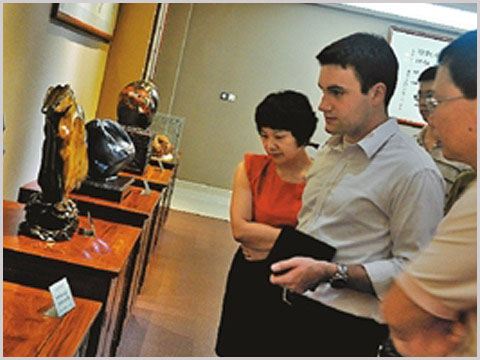
His efforts have been fruitful. A newly minted museum and a well-loved plaza mark some of the landmarks in Shuiwei, developments that cause even the most callous observer to understand and appreciate the village. Yet the continued renaissance of the village is more than just a consciously planned policy; it is built into the fabric of the place.
Shuiwei has become one of the most interesting and lively places in Shenzhen.
A close friend of mine in Hong Kong, when visiting Shenzhen, often repeats the now-hackneyed slogan that Shenzhen is a “cultural desert.” When I press him on the issue of Shuiwei, Xiasha and other points of note, he lessens up, consenting that these villages are “oases of the desert.” Yet this is still an unfair analogy. After all, is not the most fertile soil that in which a river cuts through the desert sands? We are still witnessing the dawn of a city, yet we are closing in on a turning point. Whether measured in years or decades, with the economic metamorphosis nearing completion, the next stage of Shenzhen’s development is sure to be cultural.
Any true traveler would love to find themselves immersed in the narrow streets of Futian’s villages. To this end, a handful of voices have called for such villages to be preserved. I am usually sympathetic to this line of thinking, but find it lacking in ambition. The style of urbanism that can be found here is unique, yet not without precedent. Shuiwei is not simply worth protecting, it is worth emulating.
(Chris Thomas is the financial controller of Jiahua School, a professional language school.)